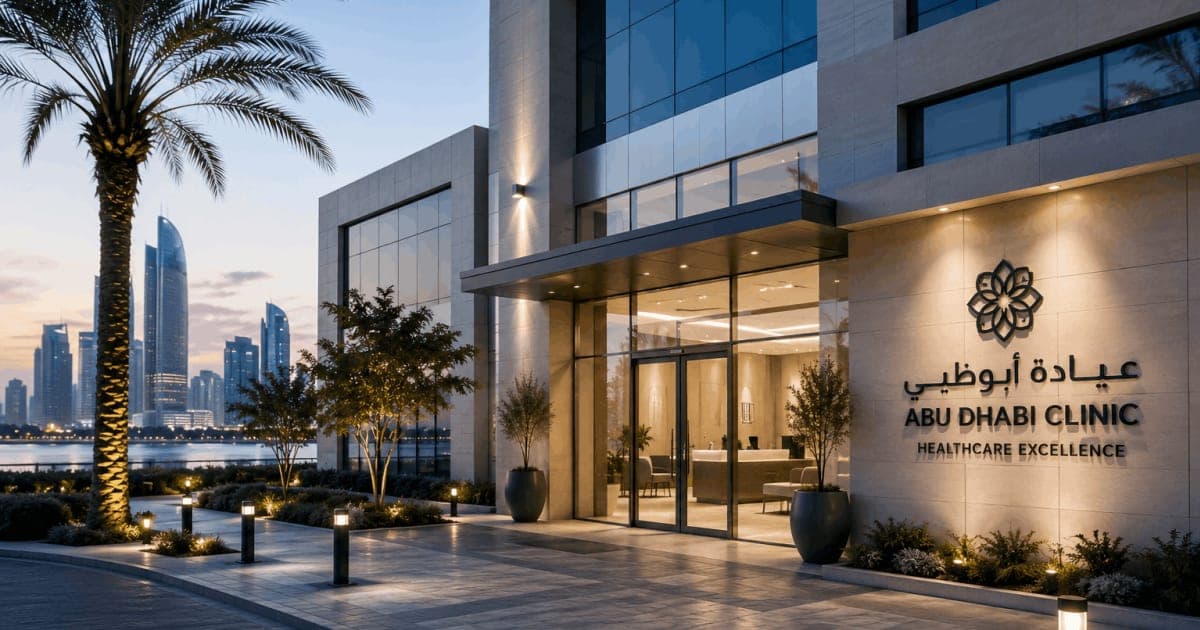
Abu Dhabi or Dubai? Where to Buy a UAE Healthcare Facility
Two emirates, two regulators, two payer models. How DHA and DoH differ, why Thiqa and medical tourism pull in opposite directions, and which questions actually decide an acquisition.

Investors evaluating UAE healthcare usually start with a question that sounds simple and is not: Abu Dhabi or Dubai?
The two emirates are frequently discussed as one market. For a healthcare property investor they are not. They have separate regulators, separate licensing platforms, separate health record mandates and materially different payer mixes. Those differences change which facilities are worth owning, and what you should pay.
The regulatory comparison
| Dubai | Abu Dhabi | |
|---|---|---|
| Regulator | Dubai Health Authority (DHA) | Department of Health (DoH) |
| Licensing portal | Sheryan | TAMM |
| Commercial licence | Department of Economy and Tourism | ADDED |
| Health record mandate | NABIDH | Malaffi |
| Imaging | DHA approvals | DoH plus FANR authorisation |
| Government payer for nationals | — | Thiqa, via Daman |
None of this makes one emirate better. It does mean an acquisition team experienced in one is not automatically competent in the other, and that a valuation model built for one needs rebuilding for the other.
Where the demand comes from
Both emirates benefit from the same national tailwind. Mandatory health insurance now applies across all seven emirates, having reached the Northern Emirates on 1 January 2025 with a minimum annual benefit of AED 150,000. That underwrites a floor of insured demand everywhere.
Above that floor, the two diverge.
Dubai leans on medical tourism
Dubai ranks sixth globally on the Medical Tourism Index, and the UAE treats patients from more than 150 countries. Dubai attracted over 691,000 international health tourists in 2023. Dubai Healthcare City is partway through an AED 1.3 billion expansion aimed squarely at positioning the emirate for European and Asian medical travel.
The UAE medical tourism market was worth roughly USD 866 million in 2025 and is projected to approach USD 4.5 billion by 2034, a compound annual growth rate near 20%. A significant share of that flows through Dubai.
For an investor, medical tourism means higher-margin elective and aesthetic work, greater sensitivity to brand and international accreditation, and revenue that is less predictable than insured local demand.
Abu Dhabi leans on structured local demand
Abu Dhabi's distinguishing feature is Thiqa: a government-funded programme for UAE nationals, reimbursing 100% at government facilities and 80% at private facilities within the emirate, and limited geographically to Abu Dhabi and Al Ain.
Only around 46 DoH-licensed hospitals and medical centres in Abu Dhabi are on the Thiqa network. That is a narrow door, and it is the central strategic fact about the emirate.
Revenue of this kind is contracted and repeatable rather than discretionary. It is, in valuation terms, higher quality earnings than elective cash work, because it is more forecastable.
What this means for what you buy
Reduced to its essentials:
- In Dubai, you are often buying reach. Brand, location, international patient flow and elective service mix carry disproportionate weight. Assets can command strong multiples on growth, but the earnings are more cyclical.
- In Abu Dhabi, you are more often buying access. Thiqa status, DoH licence category and Malaffi compliance are the gates, and a facility that has already passed through them holds something a new entrant cannot simply purchase.
UAE healthcare businesses broadly trade in the region of six to ten times EBITDA, among the highest ranges in the UAE market, supported by licensing barriers, insured demand and active consolidation. Both emirates sit inside that band. What differs is which characteristics move a specific asset to the top of it. Our guide to valuing a UAE medical practice covers the mechanics.
The compliance obligations are not symmetrical
Both emirates mandate a health information exchange, but the enforcement differs in a way that matters during diligence.
In Abu Dhabi, a non-exempt facility that has not completed its Malaffi connection cannot renew its DoH licence. That converts a technical integration task into an existential one, and makes Malaffi status a first-order diligence question rather than an IT footnote.
Dubai's NABIDH is likewise a licensing condition, and both emirates require Civil Defence clearance and an approved facility layout. But an Abu Dhabi buyer needs to establish the Malaffi position before agreeing a price, and needs to add FANR to the timetable the moment imaging enters scope.
So which one?
The honest answer is that the emirate is the wrong unit of analysis. The right questions are about the asset:
- Is the licence clean, and does its category match what the facility actually does?
- Which payers does it hold contracts with, and what share of revenue do they represent?
- Does the revenue survive the current owner leaving?
- Is the health record obligation satisfied, or is it a bill you are about to inherit?
- How long is the lease, and can it be assigned?
A well-run Abu Dhabi polyclinic on the Thiqa network is a better asset than a poorly documented Dubai clinic with a short lease, and the reverse is equally true. The emirate determines which rules apply. It does not determine whether a given facility is worth buying.
For the emirate-specific process, see our guides to buying a clinic in Dubai and buying a clinic in Abu Dhabi.

Written by
Dr. Asmaa Al-NajjarFounder, MedProp
Dr. Asmaa Al-Najjar is the founder of MedProp, the strategic arm of MedStream. She combines a medical background with strategic economic expertise, and established MedProp to bridge traditional healthcare sectors with the future of digital health and investment across the UAE.